If you’re still clutching your battered copy of the Cyber Kill Chain, it’s probably gathering dust next to your 2012 firewall manual. The cybersecurity world loves its frameworks and step-by-step guides, but unfortunately, hackers—and now AI agents—don’t much care about your stage-by-stage checklists. The Cyber Kill Chain, once held up as gospel by everyone from junior analysts to CISO PowerPoint evangelists, is rapidly becoming useless noise in a world where autonomous AI agents are running the show.
Kill Chain: Constructed for Yesterday’s Threats
Let’s refresh your memory. The Cyber Kill Chain—a Lockheed Martin creation—tries to map every cyberattack into neat phases: reconnaissance, weaponization, delivery, exploitation, installation, command and control, and finally, whatever the attacker wanted in the first place. It’s tidy, comforting—and about as relevant as floppy disks for stopping what’s coming next.
For years, defenders built layers of detection, monitoring, and mitigation around these stages. Stop the attacker at any point, the logic went, and the whole operation collapses. This framework’s predictability is precisely why attackers—and, more dangerously, their AI proxies—are blowing past it without breaking a sweat.
Enter the Autonomous AI Agent—And The Rules Change
If you think AI is just about chatbots making spelling mistakes in emails, you’re hopelessly out of the loop. We’re talking about autonomous AI agents: machine learning-powered decision-makers that learn, adapt, and act without human babysitting. In cybersecurity, these agents aren’t just used by defenders—hackers have plenty of uses for them, too. They operate around the clock, don’t complain about morale, and never get bored. And yes, they’re able to blast straight through process-heavy defenses with unsettling efficiency.
- They make independent decisions using real-time data.
- They adapt—sometimes startlingly fast—if they run into defensive friction.
- They integrate with countless platforms, running attacks faster than any flesh-and-blood intruder could dream of.
The moment you realize an adversary’s AI is running loose inside your network, forget about staging a classic defense. This isn’t chess; it’s wack-a-mole with superintelligent rodents.
The Death Spiral of the Linear Attack Model
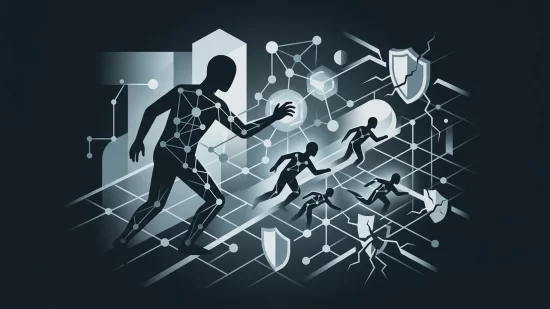
The kill chain assumes the attacker acts in a straight line. Guess what? AI agents don’t. Instead, they jump around, switch up approaches, and ignore the sequence entirely. If your defenses depend on intercepting “phase three” or “step five,” you’ve already lost. Put simply, the following traditional approaches are either useless or laughably inadequate:
- Perimeter defense: Irrelevant when the “attacker” is an AI agent with a badge—acting as an insider.
- Static rules: AI rewrites the playbook in real time, so your static rules age faster than milk in the sun.
- Incident response: By the time your team has scheduled a meeting, the AI has already moved on, mutated, or handed the baton to another agent.
When AI Agents Go Wild: Breaches You Couldn’t Predict
The shift isn’t theoretical either. If you’re waiting for some grand, future-tense disaster, bad news: the breaches are already happening. Just look at OpenClaw and Moltbook. OpenClaw, sold as the next-gen AI helper, let users connect email accounts and calendars. But misconfigured instances allowed prompt injection attacks—meaning attackers embedded silent instructions to make the AI behave badly, like a well-behaved intern suddenly running off with your data while smiling. At least one third-party "skill" exfiltrated data without anyone batting an eye.
Moltbook was even more farcical, showing the cost of trusting platforms with any whiff of "autonomy." Its poorly-shielded database let anyone hijack any AI agent on the platform, skipping authentication entirely. If that’s not chilling, remember: sensitive API keys and even “owner” account relationships were up for grabs. One day you’re monitoring normal operations, the next day your entire workforce of AI helpers is taking orders from an attacker.
Let’s not forget about the medical sector, the supposed stronghold of caution and redundancy. There, a simple adversarial prompt (in-nocuous-looking, embedded on a webpage) could trick a "medical" AI agent into stealing patient data, returning malicious links, or corrupting diagnoses. If you think compliance checklists and outdated frameworks can block that, I’ve got some snake oil to sell you.
Why It’s So Hard to Even Spot These Threats
Here’s what will really keep you up at night: the traditional steps for stopping an attack evaporate when AI agents are inside the perimeter. Detection? AI blends in, automating tasks and looking just like every other bot. Insider threat programs were never designed to account for autonomous codebases running their own schedules. And since AI can retune behaviors on the fly, labels like “malicious” or “benign” lose meaning.
Even attribution, the favorite pastime of boardroom security briefings, breaks down. When an AI agent pulls off an attack, you’re no longer asking “who” but “what”—and sometimes, “why was this AI doing that at all?” Chasing the responsible party can mean tracing a digital daisy chain back through compromised agents, legitimate tools, and weirdly specific code injections. Good luck presenting that to your insurance provider.
Your New (and Unwelcome) Security Priorities
If you’re in security, you have a few uncomfortable choices. Frameworks built on sequence and predictability won’t cut it. You need new strategies—ones that you’re probably still scrambling to define. Some semi-useful priorities as you limp into this AI-infested future:
- Dynamic threat models: Model non-linear, adaptive attack patterns instead of obsessing over the checklist fantasy.
- Insider threat programs—reimagined: Start assuming “insider” means code, not just people. Trust but verify your agents.
- Adaptive defense: Use machine-learning defenses that actually learn, just like the attacker’s tools do. Static systems are dead systems.
- Better attribution: Get creative (and paranoid) about tracing attacks—sometimes it’s the code you bought last week that’s plotting your downfall.
Good luck finding off-the-shelf tools or consultants with real answers. Everyone’s terrified, and rightly so. If you’re still sleeping soundly, you’ve either unplugged your infrastructure already—or you have no idea what’s lurking in your network’s “trusted” corners.
This Is the Messy Future. Are You Ready?
AI agents aren’t going away. If anything, they’re multiplying, evolving, and seeping into every digital process you can think of, both legitimate and malicious. The Kill Chain was built for a more innocent time, when attackers followed predictable scripts and defenders could almost keep up. Now, in a world where computers learn to hack by themselves, you need more than a seven-step framework. You need improvisation, paranoia, and most of all, humility in the face of a threat that couldn’t care less about your best practices.